
Your Body Doesn’t Know What’s “Natural.” It Responds to Chemistry.
The hidden chemistry behind botanical oils and why it matters more than the marketing language on the label
At Beauty in Us, we choose organic botanical ingredients because their origin, quality and environmental impact matter to us.
However, the word “natural” does not tell us everything we need to know about an ingredient.
The skin does not recognise whether an oil has been described as rare, luxurious, clean or botanical. It responds to the compounds within that oil and to the way those compounds behave in a finished product.
Botanical oils contain fatty acids, triglycerides, plant sterols, tocopherols, carotenoids, squalene, waxes and other naturally occurring substances. These influence an oil’s colour, stability, character and role within a blend. [1,2]
Two oils may both come from plants and still behave very differently because their chemical profiles are not the same.
Botanical oils are complex chemical structures
Botanical oils are often described simply as moisturising ingredients. While they can help the skin feel softer and more comfortable, that description does not explain why one oil feels light while another feels rich, or why one may suit a particular product better than another.
Most plant oils are made primarily from triglycerides. A triglyceride consists of three fatty acids attached to a glycerol molecule. The types and proportions of those fatty acids vary between oils, giving each one a different chemical profile. [1,2]
Some oils contain higher levels of oleic acid, while others contain more linoleic acid. Palmitic, stearic and alpha-linolenic acids may also influence the oil’s overall character. [2]
Jojoba differs from many familiar plant oils because it consists mainly of wax esters rather than conventional triglycerides. [3]
These variations are why Camellia, Sunflower, Rosehip, Jojoba and Sea Buckthorn are not interchangeable. Each brings a different structure and character to a blend.
Different oils behave differently
The chemistry of an oil helps shape the way it behaves in a finished product.
Some oils feel naturally lighter, while others are richer or more substantial. Some have a strong colour or aroma, while others are relatively neutral.
These differences do not mean that one oil is always better than another.
An oil that works well in one product may be less suitable in another. A richer oil may be useful when a formula needs more body, while a lighter oil may help create balance. An oil with a strong natural colour or aroma may also need to be used carefully so that it does not dominate the blend.
The useful question is not, “Which botanical oil is best?” It is, “What does this oil contribute to this formula?”
It's a little like asking whether a chef should always use olive oil instead of sesame oil. The answer depends entirely on the dish they're creating. Formulators think in much the same way. Every botanical oil contributes something different, and the goal isn't to find the "best" oil. It's to choose the right combination for the formula.
An ingredient may be popular or impressive on a label, but it still needs a clear role within the complete product.
BEYOND fatty acids: the unsaponifiable compounds
Fatty-acid profiles are important, but they do not describe the full composition of a botanical oil.
Plant oils also contain smaller amounts of naturally occurring substances known as unsaponifiable compounds. These may include phytosterols, carotenoids, tocopherols, tocotrienols, squalene and other plant constituents. [2]
Although present in smaller quantities, these compounds can influence an oil’s colour, stability, antioxidant profile and overall complexity. [2]
Sea Buckthorn offers a useful example of why composition matters. Its deep orange colour comes naturally from carotenoids, while other botanical oils are almost colourless. These visible differences reflect deeper differences in chemical composition, and remind us that every botanical oil brings its own unique profile to a formulation. [4]
Research into vegetable oils confirms that these minor compounds vary according to the plant source and the way the oil is produced. [2]
This is why an oil cannot be judged by one fatty acid or a familiar ingredient name. Its complete composition matters.
Processing changes the finished ingredient
The botanical name on a label does not tell us everything about the oil inside the product. Extraction, heat exposure, refining, deodorising, bleaching, storage and handling can all affect the final ingredient. [2,3]
Some processing methods improve consistency, stability or neutrality. At the same time, they may reduce the oil’s natural colour, aroma or concentration of certain unsaponifiable compounds. [2,3]
A highly refined oil may be clearer, more uniform and easier to use when a neutral aroma or consistent finish is important. A less refined oil may retain more of its original colour, scent and botanical character.
Neither option is automatically better. The appropriate choice depends on the purpose of the finished product.
The word “natural” does not reveal how an oil was extracted, refined, stored or preserved. Two oils with the same botanical name may therefore differ in colour, aroma, stability and composition.
Why balance matters more than a hero ingredient
Beauty marketing often places one ingredient at the centre of a product story.
A single oil may have valuable qualities, but a balanced formula usually needs several different contributions.
One oil may bring softness, another may add richness, and another may contribute wax esters, carotenoids or a lighter overall character. The aim is not to find one perfect oil, but to understand how several oils can work together.
Susan M. Parker describes oil formulation as a balance of art and science. It requires an understanding of fatty acids, unsaponifiable compounds, antioxidants and the physical character of each oil before they are combined with purpose.
This guided the development of the Beauty in Us Body Ritual Collections.
Camellia was selected for its soft, elegant character. Jojoba contributes its distinctive wax ester structure. Sunflower provides a linoleic-rich profile. Rosehip brings essential fatty acids and naturally occurring plant compounds. Sea Buckthorn adds richness, carotenoids and its characteristic colour. These oils were not chosen simply to make the ingredient list longer. Each one has a role within the blend. [2,3,4]
A formula with many botanical oils is not automatically more sophisticated than one made with fewer ingredients.
In some cases, adding more oils can make a product harder to balance, especially when several ingredients have similar qualities or strong natural colours and aromas.
Thoughtful formulation often requires restraint. What matters is whether each oil contributes something useful, complements the other ingredients and helps create a coherent finished product.
What “natural” can and cannot tell you
The word “natural” may tell us something about where an ingredient came from.
It does not reveal its fatty-acid profile, minor plant compounds, processing, stability, concentration or role within the formula.
Those questions require a closer look at chemistry and formulation.
For Beauty in Us, choosing a botanical oil is the beginning of the process rather than the end. We also consider its composition, quality, processing and purpose within the complete product.
Natural matters, but it is not the whole story.
What this means for your body care
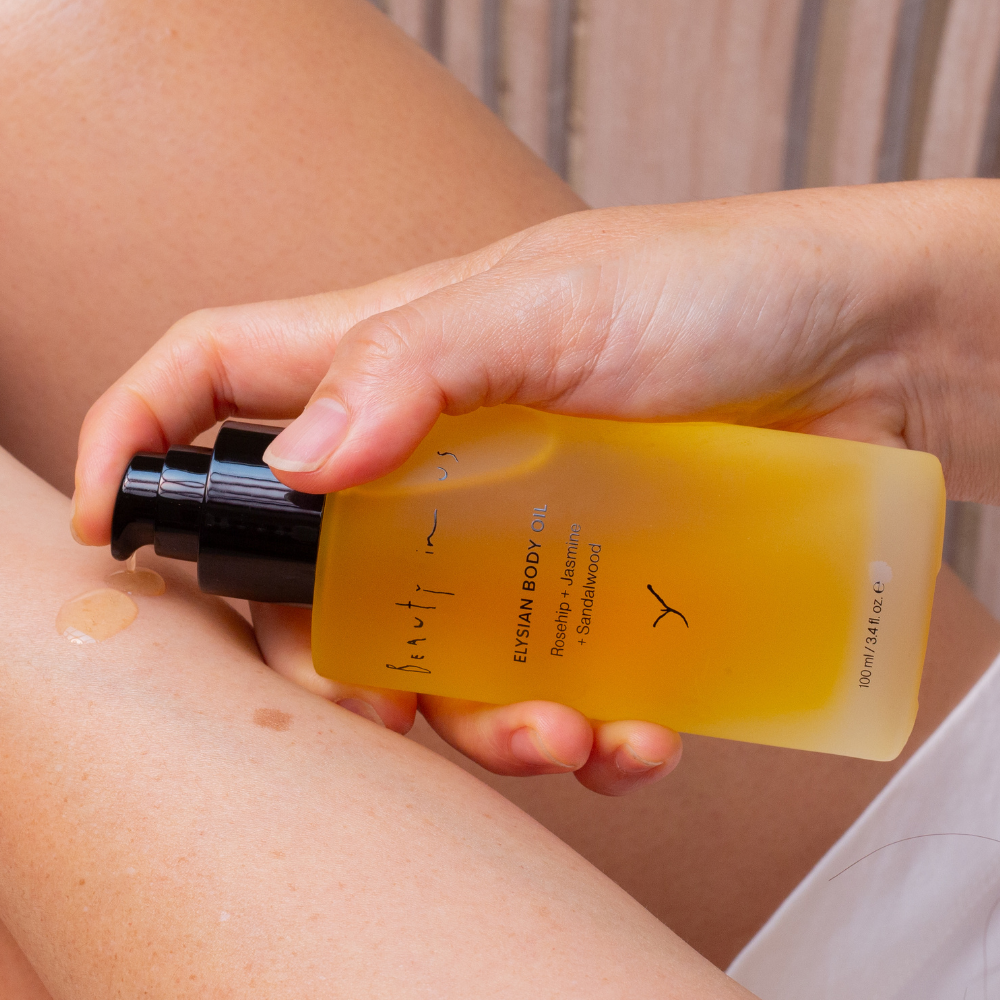
When you apply a botanical body oil, you are applying a blend shaped by the composition, quality and processing of its ingredients.
This is why the Beauty in Us Body Ritual Collections were developed by looking beyond attractive ingredient names. Each oil was selected for the role it plays within the formula rather than for its rarity, price or popularity.
The word “natural” tells us where an ingredient began.
Its chemistry and place within the blend explain why it belongs in the finished product.
References
- Susan M. Parker, Facial Oil Formulation: Nature of the Lipid Oils This material explains that natural lipid oils and butters are made primarily from triglycerides and that fatty-acid proportions differ between oils. Course material. No public source link available.
- Tian, M., Bai, Y., Tian, H. and Zhao, X. “The Chemical Composition and Health-Promoting Benefits of Vegetable Oils—A Review.” Molecules, 2023, 28(17), 6393. https://www.mdpi.com/1420-3049/28/17/6393
- Abdalla, S. et al. “A Comprehensive Review of Plant-Based Cosmetic Oils: Chemical and Biological Properties, Production Processes, and Applications.” International Journal of Molecular Sciences, 2024. https://pubmed.ncbi.nlm.nih.gov/39524627/
- Ciesarová, Z. et al. “Why Is Sea Buckthorn (Hippophae rhamnoides L.) So Exceptional? A Review.” Food Research International, 2020. https://pubmed.ncbi.nlm.nih.gov/32466930/

Written by Ana Paula Maielo