Beyond Scent: The Lipid Science Behind Body Oils
The Foundation of Every Great Body Oil
When we choose a body oil, we usually notice the scent first. Maybe the texture. Perhaps the glow it leaves on the skin.
But none of those things tells us what makes a body oil exceptional. Long before a fragrance is added, every body oil is built on something far more important: its lipid base.
These botanical carrier oils make up the majority of the formula, and their unique chemistry determines how the oil spreads, how it feels on the skin, and why some body oils become daily rituals while others end up forgotten in the bathroom cabinet.
Scent may create the first impression. But the botanical oils beneath it are what determine how the formula performs on the skin.
The carrier oils are the formula
In some beauty products, botanical oils are included in small amounts to support a larger formula. In a body oil, they are the formula.
Each botanical oil has its own character. Some are light and fluid. Others are richer or more substantial. Some spread easily across the skin, while others leave a more noticeable layer after application.
A formulator considers how these oils work together rather than relying on one ingredient to do everything.
One oil may bring lightness to the blend, while another contributes richness or improves the way the formula moves across the skin. The final balance determines whether the product feels comfortable, practical and suited to its intended use.
This is why a body oil cannot be judged by its aroma alone. A beautiful scent cannot compensate for a base that feels sticky, heavy or difficult to apply.
Why lipids matter in body care
Botanical oils are made primarily of lipids. Lipids are also an important part of the skin’s outer barrier.
The outermost layer of the skin, known as the stratum corneum, helps limit water loss and protect the body from environmental exposure. Lipids contribute to the structure and function of this barrier. [1]
Body oils do not add water to the skin in the same way as a water-based moisturiser. Instead, they leave an oil-based layer on the surface of the skin. This can help reduce the feeling of dryness and leave the skin feeling smoother and more comfortable. [2]
The result depends on the formulation. Two body oils may both contain botanical ingredients but feel completely different because their lipid bases have been constructed differently.
The oils chosen, their proportions and the way they work together all influence the finished product.
Not all botanical oils behave in the same way
Botanical oils contain different combinations of fatty acids, including linoleic acid, oleic acid, palmitic acid, stearic acid and alpha-linolenic acid.
The proportions vary between oils. These differences influence how an oil behaves within a formula and the kind of skin feel it can help create. [2,3]
An oil with a lighter character may make a blend easier to spread. A richer oil may add more cushion or leave a more substantial finish. Neither is automatically better. The right choice depends on the role the oil needs to play in the complete formulation. [3,4]
This is also why broad descriptions such as “natural” or “premium” tell us very little about how a body oil will perform. [3,4]
A natural ingredient still needs to be chosen for a reason. An expensive or fashionable oil does not automatically improve a product. What matters is whether each ingredient contributes something useful to the blend.
A thoughtful formula is not defined by how many oils it contains. It is defined by how well those oils work together.
Texture is a result of formulation
The texture of a body oil comes from the types of oils used and the proportions in which they are combined.
Some blends feel light and settle quickly. Others feel richer and leave a more noticeable layer on the skin. These differences are not simply matters of preference. They are outcomes of formulation.
A body oil should move easily enough to apply across a larger area of the body. It should settle comfortably and leave a finish that makes sense for the way the product is intended to be used.
Fast absorption is not the only sign of a good body oil. A formula does not need to disappear immediately to feel elegant. What matters is that it spreads evenly, does not feel unnecessarily sticky and leaves the skin feeling comfortable.
Climate, skin feel and personal preference may also affect how a texture is experienced. There is no single finish that will suit every person or every situation.
The goal is not to create one universally perfect texture. It is to create a balanced and purposeful one.
Scent should work with the base
Scent can give a body oil its identity and make it more enjoyable to use. But it should complement the lipid base rather than become the only reason the product exists.
A well-formulated body oil still needs to perform when the scent is set aside. It should spread well, feel comfortable and work as a regular part of body care.
The aromatic ingredients and carrier oils should be considered together. The fragrance should suit the character of the formula without masking an unbalanced base or overwhelming the application experience.
Scent can make the first impression, but the quality of the formulation determines whether the product becomes part of a routine.
Why We Formulate Body Care with the Same Care as Facial Skincare
For decades, innovation in skincare has focused primarily on the face. Yet the skin below the neck is exposed to the same sun, changing seasons, friction, hormonal shifts and passage of time.
At Beauty in Us, we don't believe the body deserves less thoughtful care than the face.
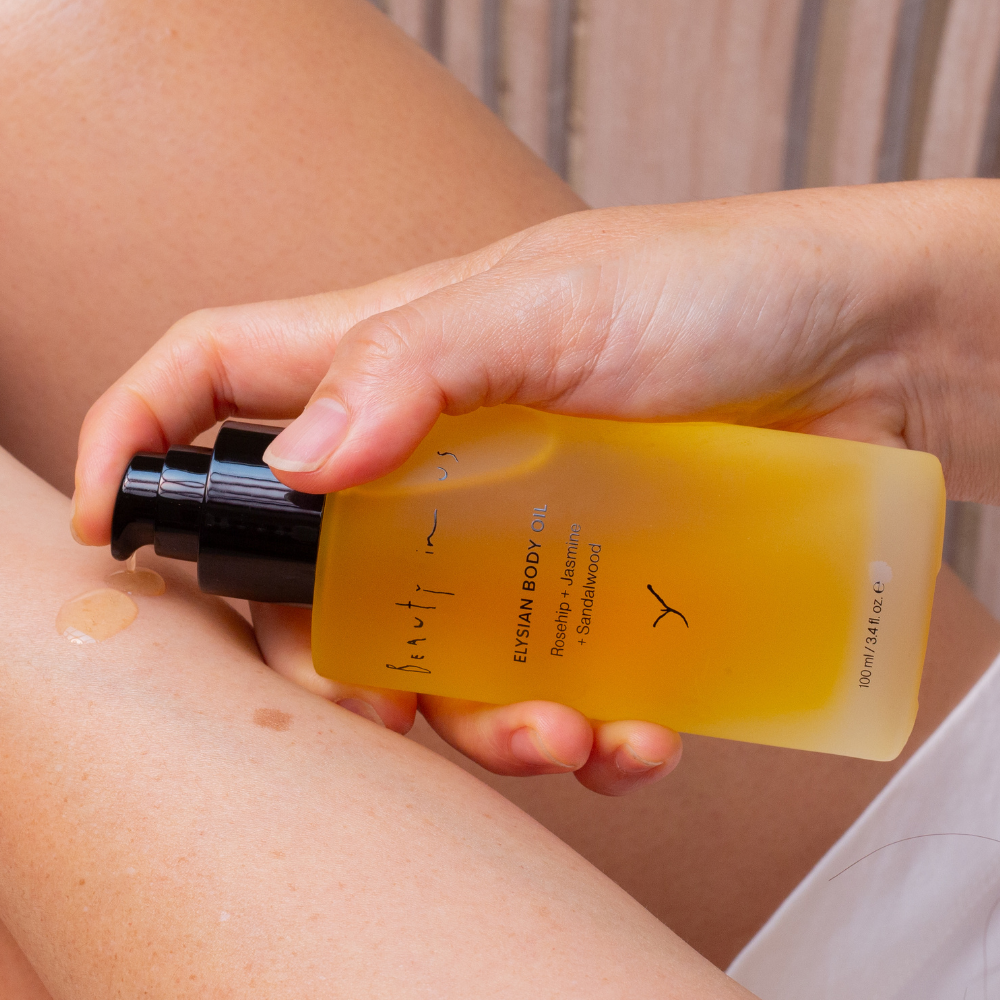
That's why we formulate our body oils with high-quality organic botanical oils, selected not because they sound impressive on a label, but because of their lipid composition, skin feel and the role each one plays within the complete formula.
We approach body care with the same level of scientific thought, formulation expertise and ingredient quality often associated with premium facial skincare.
The difference Is in the Formulation
A body oil is more than fragrance carried in botanical oils.
It is a lipid-based skincare formula shaped by the oils selected, their natural composition, the proportions in which they are used and the way the finished blend performs on the skin.
Scent may draw someone to a product. The formulation determines how it feels to use and whether it earns a lasting place in their routine.
At Beauty in Us, body care is not an afterthought. We believe the skin on the body deserves the same considered approach to ingredients, formulation and scientific care that is often reserved for the face.
References
- Berdyshev, E. et al. “Skin Lipid Barrier: Structure, Function and Metabolism.” Allergy, Asthma & Immunology Research, 2024. https://pubmed.ncbi.nlm.nih.gov/39363765/
- Lin, T.K., Zhong, L. and Santiago, J.L. “Anti-Inflammatory and Skin Barrier Repair Effects of Topical Application of Some Plant Oils.” International Journal of Molecular Sciences, 2018. https://pubmed.ncbi.nlm.nih.gov/29280987/
- Vaughn, A.R., Clark, A.K., Sivamani, R.K. and Shi, V.Y. “Natural Oils for Skin-Barrier Repair: Ancient Compounds Now Backed by Modern Science.” American Journal of Clinical Dermatology, 2018. https://pubmed.ncbi.nlm.nih.gov/28707186/
- Danby, S.G. et al. “Effect of Olive and Sunflower Seed Oil on the Adult Skin Barrier: Implications for Neonatal Skin Care.” Pediatric Dermatology, 2013. https://pubmed.ncbi.nlm.nih.gov/22995032/

Written by Ana Paula Maielo