Why the Body May Need More Rest During Bleeding
Rest is not something women should have to earn. During bleeding, it can be a practical way to support the body while it carries out active biological work.
Many women are used to treating rest as something that comes after the work is finished, responsibilities are handled, and everyone else has been cared for.
Menstruation may require a different approach.
During bleeding, the uterus sheds its lining, contracts, and begins the process of repair. Although menstruation is a normal part of the cycle, it is still an active biological event that can affect energy, comfort, sleep, and the amount of pressure a woman feels able to manage.
For some women, this phase passes with only mild changes. Others may experience cramps, fatigue, digestive discomfort, disrupted sleep, mood changes, heavier bleeding, or a stronger desire to slow down.
Rest during this time is not a sign of laziness or a lack of resilience. It can be a reasonable response to what the body is already doing.
What happens in the body during menstruation
During the menstrual phase, the uterus sheds the endometrial lining that developed during the previous weeks of the cycle.
To help release this lining, the uterus contracts. These contractions are influenced by prostaglandins, which are natural chemicals involved in inflammation and muscle activity. Prostaglandin levels are often highest at the beginning of the period, which is one reason cramping may feel stronger during the first day or two of bleeding. [1]
The intensity of this experience varies from one woman to another. Some women notice mild pressure or discomfort, while others experience stronger cramps, back pain, headaches, nausea, fatigue, or digestive changes.
Menstruation also involves a controlled inflammatory response within the endometrium. This inflammation helps the tissue break down and supports the processes of bleeding and repair. [3]
These changes do not mean the body is unwell. They show that menstruation involves contractions, tissue breakdown, inflammation, and repair, rather than only the visible loss of blood.
Why energy may feel lower
In the days before bleeding begins, estrogen and progesterone decline. These hormonal changes may contribute to lower energy, greater sensitivity, and a reduced desire for intense activity or constant productivity. [2]
The experience is not the same for every woman or every cycle. Energy may remain steady during one period and feel noticeably lower during another. Stress, sleep, pain, nutrition, workload, and the heaviness of the bleeding can all influence how the phase feels.
When cramping, poor sleep, or fatigue is present, maintaining the usual pace may place more strain on the body. Slowing down does not mean the body is failing to cope. It means the usual level of demand may feel less manageable during this phase.
Sleep, pain, and fatigue during the period
Sleep can also change before or during menstruation.
Research has linked menstrual disturbances, period pain, and premenstrual signs with poorer sleep quality, fatigue, and daytime sleepiness. [4] Discomfort may make it harder to fall asleep, remain asleep, or feel fully rested the following day.
When sleep is lighter and pain is present, pushing through an intense schedule can leave the body feeling more depleted. Rest may therefore involve more than spending time in bed. It may mean reducing unnecessary activity, going to sleep earlier, allowing more time between tasks, or choosing gentler movement.
The purpose is not to avoid daily life, but to reduce additional strain while the body is managing discomfort, bleeding, and repair.
Modern routines do not always reflect the menstrual cycle
Most daily routines are built around consistency. Women are often expected to work, exercise, care for others, remain socially available, and maintain the same level of productivity every day.
The menstrual cycle does not always follow that expectation.
For women who experience cramps, fatigue, heavy bleeding, poor sleep, mood changes, or increased sensitivity, the first days of menstruation may feel different from the more energetic parts of the cycle.
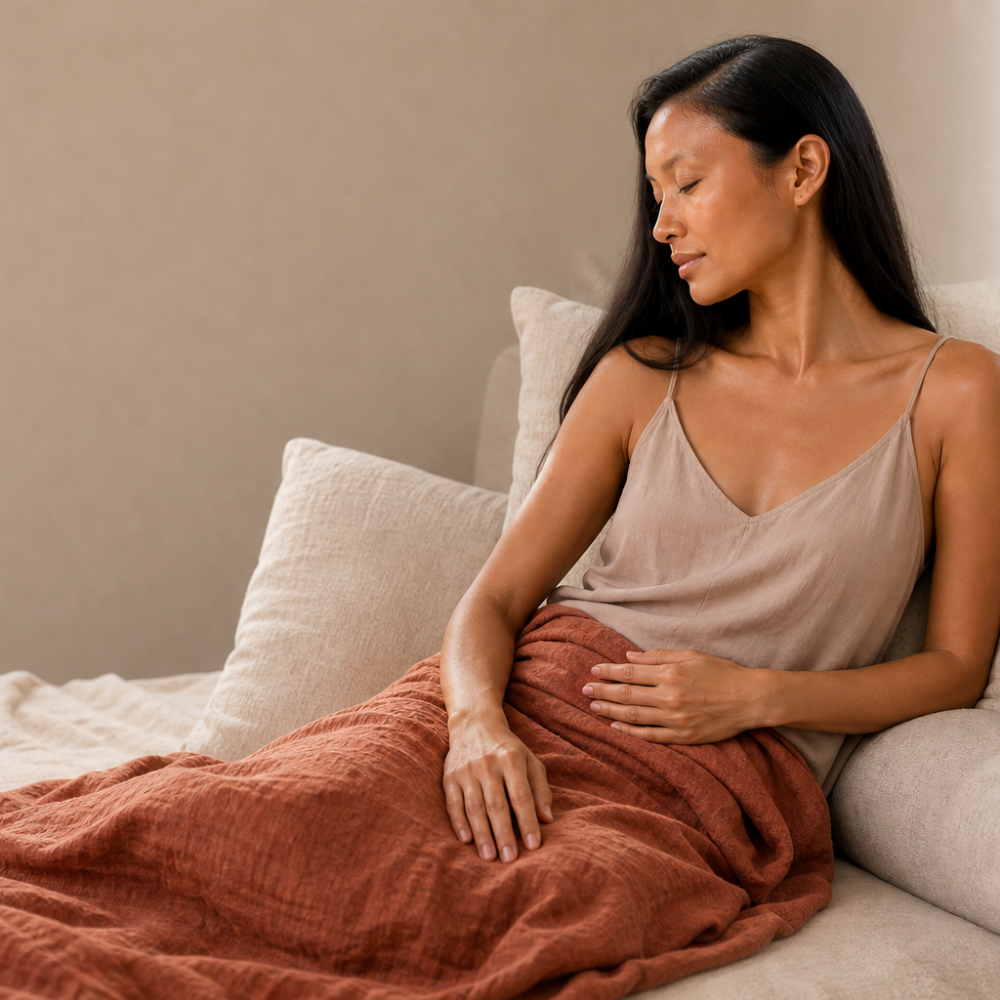
A slower pace does not require withdrawing from life or following strict cycle rules. Some women may feel comfortable maintaining their usual schedule, while others may benefit from reducing physical intensity, simplifying their routines, or allowing more time to recover.
The most useful approach is one that responds to the individual experience rather than assuming every period should feel the same.
Practical ways to reduce strain during bleeding
Rest does not always mean doing nothing. It can mean making small adjustments that reduce the amount of pressure placed on the body.
During the bleeding phase, this may include:
-
choosing gentler movement when intense exercise feels uncomfortable
-
using warmth to ease physical discomfort
-
going to bed earlier when sleep or energy has been affected
-
leaving more time between demanding tasks
-
reducing unnecessary social or sensory stimulation
-
using slower, softer touch during body care
-
keeping routines simple when energy is limited
-
allowing non-essential tasks to wait
These adjustments are practical options, not requirements for a perfect menstrual ritual. Their purpose is to make the day more manageable without creating another set of expectations.
Why body care may need to feel different during bleeding
Body care during menstruation does not need to be complicated.
When the skin feels tender, the body feels tired, or the senses feel more easily overwhelmed, a lengthy or highly stimulating routine may feel like another task. A simpler ritual can still nourish the skin while requiring less effort.
Warm water, gentle application, and a body oil used after a shower or before sleep can create a quieter transition at the end of the day.
The value of the ritual is not measured by the number of steps, but by whether it feels comfortable and manageable during this phase.
Cocoon and the menstrual phase
The menstrual phase sits at the beginning of The Four Weeks Flow™ Collection because bleeding can be a lower-energy and more physically demanding part of the monthly rhythm for many women.
Cocoon Body Oil was created for slower days, when the body may benefit from less pressure and simpler care.
Its botanical oil blend includes Camellia, Rosehip, Sea Buckthorn, and Jojoba to nourish and soften the skin. The aromatic blend includes Rose Geranium, Mandarin, Ylang Ylang, Clary Sage, Cedarwood, and Sweet Marjoram.
Cocoon can be applied after a warm shower, before sleep, or whenever a gentler body care ritual feels appropriate.
It is not intended to change the menstrual process or remove the need for medical support when pain or bleeding is severe. Its role is to offer a simple, skin-nourishing ritual that fits naturally into a slower part of the cycle.

What rest during bleeding can mean
Rest during menstruation is not about doing less for its own sake. It recognises that the body may be managing contractions, inflammation, bleeding, discomfort, disrupted sleep, and tissue repair at the same time.
Reducing strain through gentler movement, simpler body care, protected sleep, or more space between tasks may make the phase more manageable.
The body does not need to perform exactly the same way every day of the month.
Sometimes, caring for it means allowing the pace of the day to reflect the work already taking place within it.
REFERENCES
-
American College of Obstetricians and Gynecologists. “Dysmenorrhea: Painful Periods.”
https://www.acog.org/womens-health/faqs/dysmenorrhea-painful-periods -
Thiyagarajan D.K. et al. “Physiology, Menstrual Cycle.” StatPearls, NCBI Bookshelf.
https://www.ncbi.nlm.nih.gov/books/NBK500020/ -
Evans J. and Salamonsen L.A. “Inflammation, Leukocytes and Menstruation.” Reviews in Endocrine and Metabolic Disorders.
https://pubmed.ncbi.nlm.nih.gov/25346656/ -
Jeon B. et al. “Menstrual Disturbances and Its Association with Sleep Disturbances: A Systematic Review.” BMC Women’s Health.
https://bmcwomenshealth.biomedcentral.com/articles/10.1186/s12905-023-02629-0

Written by Ana Paula Maielo