Article: Menopause Isn't Just a Hormonal Transition. It's an Identity Transition.
Menopause Isn't Just a Hormonal Transition. It's an Identity Transition.
Why understanding, support, and awareness matter more than ever.
For years, I didn't know I was going through early menopause.
What I knew was that something in my body was changing, and that I no longer felt like myself.
I was experiencing severe joint pain, exhaustion, disrupted sleep, anxiety, brain fog, skin changes, and a growing sense that my body was becoming unfamiliar to me. At times, it felt as though I was being turned inside out. The physical challenges were real, and they were often difficult.
But alongside those very real physical challenges was another struggle: I didn't understand what was happening.
I didn't have the language for it. I didn't know that hormones could influence so many aspects of how we feel, think, function, recover, and move through the world.
Like many women, I spent years trying to push through experiences I didn't yet understand.
Looking back, I realise that one of the reasons menopause can feel so isolating is not simply because of the changes themselves, but because many women are navigating those changes without understanding, support or preparation.
That is why this conversation matters.
A Note on Language: signs X symptoms
Throughout this article, I intentionally use the word signs more often than symptoms. Not because the experiences women have are insignificant, and certainly not because some women don't require medical support. Many do.
Rather, it is because menopause is not a disease. It is a natural biological transition.
The word symptom often implies illness. The word sign acknowledges that the body is communicating change.
Some of those signs can be mild. Others can be profound and deeply disruptive. Both deserve to be taken seriously.
For me, this distinction matters because language shapes how we relate to ourselves. If menopause is framed only as a collection of symptoms to eliminate, we risk missing the larger conversation about understanding, support, adaptation, and care.
Menopause Is Bigger Than We Were Told
When menopause is discussed publicly, the conversation often centres around a handful of familiar topics: hot flushes, night sweats, and periods stopping. Yet the reality can be far more complex.
Menopause can affect sleep, cognition, emotions, skin, joints, bones, energy, metabolism, confidence, resilience, and overall wellbeing. Organisations such as The Menopause Society and the International Menopause Society increasingly recognise that the menopausal transition can involve a remarkably wide range of physical, cognitive, emotional, and psychological signs. Some experts describe more than sixty recognised signs associated with menopause and perimenopause, although every woman's experience is unique.
Some women experience anxiety they have never felt before. Others struggle with brain fog, forgetfulness, or difficulty concentrating.
Many report disrupted sleep, fatigue, headaches, changes in skin quality, reduced stress tolerance, or joint pain that seems to appear without explanation.
Others describe a quieter but equally significant experience: a feeling that something about themselves has changed, even when they cannot fully articulate what that change is.
And yet many women reach this stage of life having never been taught that these experiences may be connected.
This is one of the reasons menopause can feel so disorienting. Not simply because the body is changing. But because so many women are left trying to interpret those changes without understanding the broader context in which they are occurring.
The Generation That Wasn't Prepared
One of the most striking aspects of menopause is how little many women were prepared for it.
For generations, women's health received less research funding and less public attention than it deserved. Menstrual health was often considered private. Perimenopause and menopause were rarely discussed openly. Many women were taught about fertility, contraception, pregnancy and childbirth, yet received remarkably little education about their menstrual cycle and the transition that would eventually follow.
The result is that millions of women entered one of the most significant biological transitions of their lives without understanding what it might involve.
Many continued working, caregiving, parenting, leading businesses, managing households and supporting others while privately navigating changes they didn't fully understand.
When women suddenly find themselves exhausted, emotionally overwhelmed, forgetful, anxious, physically uncomfortable, or disconnected from themselves, it becomes very easy to blame themselves.
To assume they are no longer coping well enough: No longer resilient enough. No longer strong enough. No longer capable enough.
Yet often what they are experiencing is not personal failure. It is a major hormonal transition that they were never adequately prepared to understand.
Fortunately, this is beginning to change. More women are speaking openly about menopause. More healthcare professionals are advocating for education and awareness. More research is emerging. More workplaces are recognising the impact menopause can have on wellbeing and performance.
Most importantly, more women are realising that they are not alone.
When You No Longer Feel Like Yourself
One of the phrases I hear most often from women is: "I don't feel like myself anymore."
I believe this is where the conversation becomes deeper than hormones alone. Because while menopause is certainly a hormonal transition, many women experience it as something more profound.
They experience it as an identity transition. The body and skin change. Energy changes. The relationship with stress changes.
The strategies that worked for years may no longer work in the same way. The version of yourself that once felt familiar can suddenly feel more difficult to access.
You may begin questioning your confidence. Your capacity. Your appearance. Your resilience. Even your place in the world.
This is rarely discussed in conventional conversations about menopause, yet it may be one of the most significant aspects of the experience.
Many women are not simply grieving the loss of predictable hormones. They are grieving the loss of certainty. The loss of familiarity. The loss of the version of themselves they once knew.
And while that experience can be deeply uncomfortable, I believe it deserves to be acknowledged rather than dismissed.
Why Awareness Matters
One of the most powerful shifts that can occur is not necessarily physical. It is psychological. Awareness changes the question.
Instead of asking: "What's wrong with me?"
Women begin asking: "What is happening to me?"
That distinction may seem small, but it can change everything. Because understanding does not magically remove every challenge. It does not eliminate every sleepless night neither remove every difficult sign. It does not instantly restore the body to how it felt ten years earlier.
But understanding can remove something equally painful: the belief that you are broken.
It can replace confusion with context. Self-blame with self-compassion. Isolation with connection. And fear with understanding.
For many women, that shift becomes the beginning of a very different relationship with themselves.
What Women Actually Need
Women need access to informed healthcare.
They need research. They need practitioners who listen. They need conversations free from shame and stigma. They need partners, families, friends, and workplaces that understand what this transition can involve.
But I also believe many women need something else. They need permission to care for themselves differently. Not because they are weak or because they’re failing. But because their needs are changing.
For some women, menopause becomes a period of rebuilding. For others, a period of reevaluation. For many, it becomes a moment when the strategies that carried them through earlier stages of life no longer work, and they are invited to create a new relationship with themselves.
Not because the transition is easy. But because profound change often asks something new of us.
Why Beauty in Us Exists
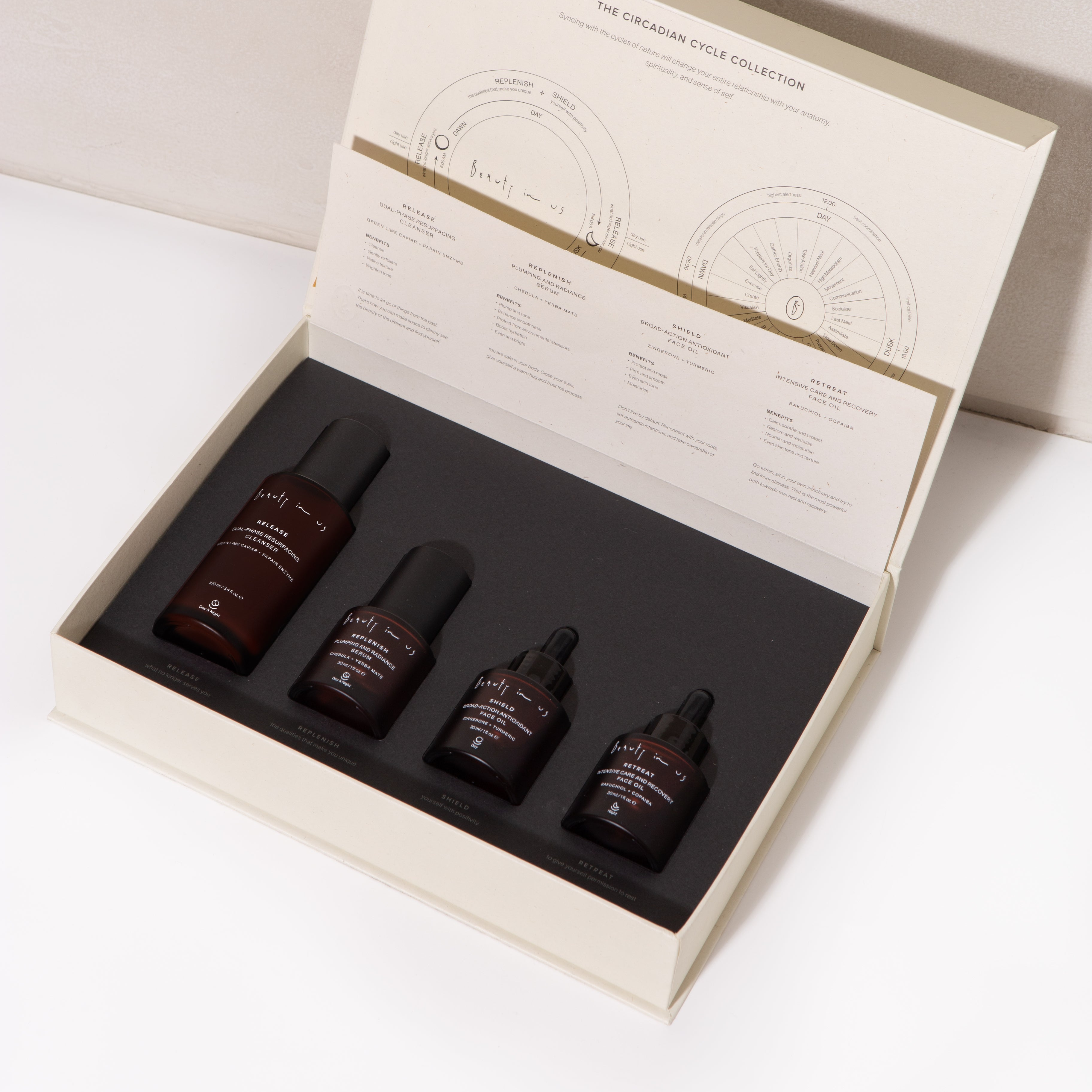
Beauty in Us was born from my own search for understanding. Not because I found all the answers. But because I realised how many women were asking the same questions.
Questions about changing skin, energy, hormones, confidence, identities. Questions about how to care for themselves in ways that felt supportive rather than corrective. Questions about how to work with their bodies rather than constantly fighting against them.
This philosophy continues to shape everything we do.
I am not saying that a skincare product can solve menopause or a body oil can eliminate every challenge.
But firmly I believe care can become a way of listening. A way of reconnecting. A way of acknowledging that skin, body, mind, hormones, stress, sleep, and emotional wellbeing are deeply interconnected.
And that women deserve care that reflects that reality.
A Different Conversation
When I look back on my own experience, one truth stands out above all others.
Many of the signs I spent years fighting against were not evidence that my body was failing. They were evidence that it was changing.
And perhaps one of the most powerful things we can offer women is not another reason to resist those changes, but the understanding, language, support, and compassion to move through them with greater confidence and self-trust.
Because menopause isn't just a hormonal transition. For many women, it is an identity transition too. And no woman should have to navigate that journey alone.
References
-
The Menopause Society – Understanding Perimenopause and Menopause
-
International Menopause Society – Menopause Awareness and Women's Health Resources
-
Office on Women's Health – Menopause
-
Harvard Health Publishing – Menopause and Mental Health
-
Harvard Health Publishing – Sleep Problems and Menopause
-
National Institute on Aging – Menopause and Your Health
-
British Menopause Society – Menopause in the Workplace

Written by Ana Paula Maielo Silva