Article: Every Woman Lives in Cycles
Every Woman Lives in Cycles
The Rhythms We Were Never Taught to Understand
For much of modern history, women's health has been overlooked, understudied, or treated as a variation of male health rather than a field deserving of its own understanding.
Medical research frequently centred on male physiology.
Menstrual health remained shrouded in stigma and silence.
Perimenopause and menopause were rarely discussed openly.
Many women entered major life transitions without adequate education, support, or even the language to describe what they were experiencing.
As a result, generations of women learned to interpret their body's messages as problems, not information.
A changing mood became something to manage.
Fatigue became something to overcome.
A disrupted sleep pattern became something to endure.
Skin changes became something to fix.
Instead of asking:
"What is my body trying to tell me?"
Many women learned to ask:
"How do I stop this?"
Somewhere along the way, we lost the understanding that our bodies communicate through change, that fluctuations are often signals, and that cycles are not failures of consistency but expressions of biology.
When We Lose Connection With Our Cycles
When we are disconnected from our natural rhythms, it becomes harder to understand what our bodies need.
We begin expecting ourselves to perform the same way every day, even when our biology is asking for something different.
During the reproductive years, this may look like recurring PMS, fatigue, emotional overwhelm, skin fluctuations, cycle irregularities, or feeling frustrated by the changing demands of the month.
During perimenopause, many women find themselves facing an entirely new landscape. Brain fog, disrupted sleep, anxiety, mood shifts, changing skin, and unpredictable cycles can create a sense of confusion and disconnection from a body that suddenly feels unfamiliar.
During menopause and beyond, women may experience dryness, sleep disturbances, hot flushes, changes in mood, and a sense that their body is operating by a different set of rules than it once did.
These experiences are often framed as problems to eliminate.
But perhaps a more compassionate perspective is this: These are often signs that the body is moving through a transition without the understanding, support, and awareness women deserve, not evidence that the body is failing but evidence that it is changing.
How Hormones Influence Skin, Mood, Energy and Sleep
Hormones influence far more than reproduction.
They help shape how we feel, how we think, how we sleep, how we recover, and even how our skin behaves.
Throughout the menstrual cycle, changing levels of oestrogen and progesterone can influence hydration, oil production, sensitivity, mood, motivation, concentration, and energy levels.
Some women notice periods of increased confidence, sociability and vitality during certain phases of the month, while other phases may bring a stronger need for rest, reflection or nervous system support.
During perimenopause, fluctuating hormone levels can create more pronounced changes. Skin may feel drier or less resilient. Sleep may become lighter or more disrupted. Energy levels may feel less predictable, while concentration, memory and emotional regulation may require greater support than before.
Menopause introduces another transition, as declining oestrogen levels can affect collagen production, skin hydration, elasticity, sleep quality and overall wellbeing.
Yet these changes are not confined to reproductive hormones alone.
The body's circadian rhythm also plays a powerful role.
This internal 24-hour clock helps regulate sleep-wake cycles, hormone production, cognitive performance, metabolism, skin repair and recovery. When our circadian rhythm becomes disrupted through chronic stress, irregular schedules, insufficient sleep or modern lifestyle demands, we often feel the effects throughout the entire body.
The important point is not to fear these changes. It is to understand them.
Because when we recognise that our skin, mood, energy and sleep are responding to an ever-changing internal environment, we can begin approaching them with greater compassion and awareness.
Every Woman Lives in More Than One Cycle
One of the greatest misconceptions about women's wellbeing is the idea that there is only one cycle that matters.
In reality, every woman lives within multiple rhythms simultaneously.
The most obvious is the menstrual cycle, which influences energy, mood, skin, cognition, recovery and emotional experience throughout the month.
Yet even women who no longer menstruate continue living within other biological rhythms.
Every day, we move through a circadian rhythm — the internal clock that influences sleep, wakefulness, hormone production, cognitive performance, skin repair and recovery.
Throughout life, we also move through broader hormonal stages, including the reproductive years, perimenopause, menopause and post-menopause.
These rhythms do not exist independently; they overlap, they interact, and they influence one another.
At any given moment, a woman may be experiencing the effects of her daily circadian rhythm, her monthly hormonal fluctuations, and the broader hormonal stage of life she is navigating.
This understanding changes everything.
Because once we recognise that our needs naturally shift, we can begin responding with greater awareness rather than frustration.
What Happens When We Stop Resisting Our Rhythms
When we stop expecting ourselves to function like machines, something remarkable happens.
We begin paying attention. Instead of forcing, we begin observing. Instead of fighting, we begin understanding. And, instead of correcting, we begin supporting.
We learn to recognise patterns rather than judge them. We become more curious about what our bodies are communicating. We develop a deeper relationship with ourselves.
Rather than viewing change as an inconvenience, we begin seeing it as information.
The goal is not perfect balance.
The goal is connection.
Because when we understand our rhythms, we are better equipped to care for ourselves in ways that feel supportive, sustainable and deeply aligned with our needs.
Reclaiming the Wisdom of Our Rhythm
Beauty in Us was created from a simple belief:
Women do not need to be fixed.
They need to be understood.
Their skin is not separate from their hormones.
Their hormones are not separate from their nervous system.
Their wellbeing is not separate from the rhythms that shape their lives.
For too long, beauty has focused on correcting perceived flaws while ignoring the deeper physiological and emotional realities women experience throughout life.
We believe there is another way, one that recognises the interconnected relationship between skin, body and mind, one that honours the changing nature of a woman's needs, one that supports rather than suppresses, and one that helps women reconnect with the wisdom that has always existed within them.
Through education, rituals and cycles-informed formulations, our mission is to help women understand their changing rhythms and cultivate a more supportive relationship with themselves.
This philosophy shapes everything we create.
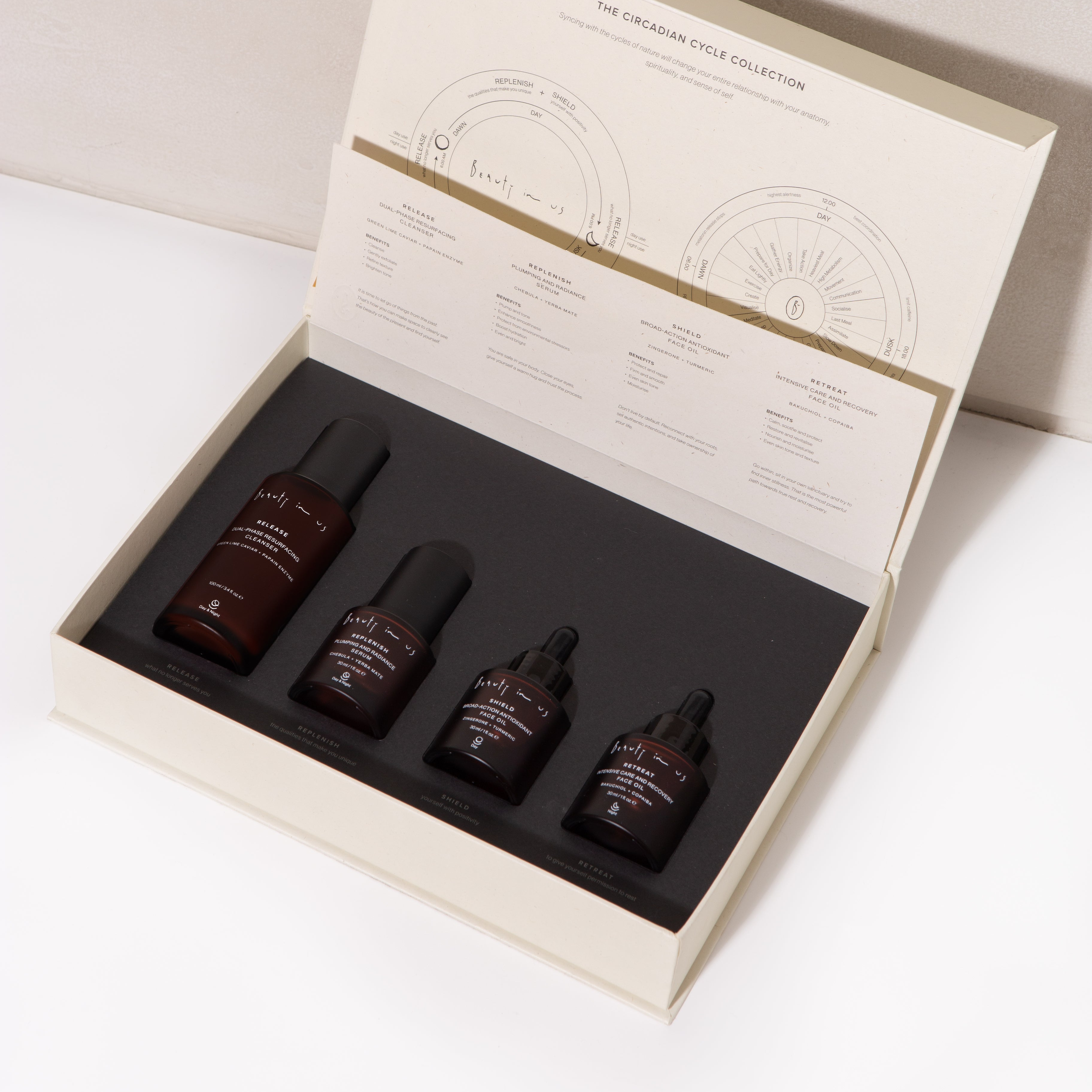
From our Circadian Collection, designed to support the natural rhythm of day and night, to our Four Weeks Flow Collection, created to honour the changing needs of the menstrual cycle, and our Flow of Wisdom Collection, developed for women navigating the profound transition of perimenopause and menopause.
Different rhythms, different seasons, and different needs, yet all connected by a single belief:
Every woman lives in cycles.
And when we learn to honour those cycles, we create space for a more compassionate, informed and empowered approach to beauty, wellbeing and self-care.
Because beauty was never meant to be about resistance.
It was always about rhythm.

Written by Ana Paula Maielo