Circadian Rhythm and Skin: Why Timing Matters in Skincare
Most skincare advice focuses on what ingredients to use.
But biology suggests something equally important: when you use them.
Your skin is not static. It follows a sophisticated 24-hour circadian rhythm, responding differently to daylight, darkness, stress signals, and the body’s internal hormonal cycles. When skincare routines ignore these rhythms, results often feel inconsistent. When care is aligned with them, the skin can become more balanced, resilient, and responsive over time.
Understanding the skin’s biological clock and learning how to work with it, is one of the most powerful shifts in modern skincare science.
Your Skin Follows a 24-Hour Biological Clock

Nearly every cell in the human body contains circadian genes – molecular clocks that regulate biological functions over a roughly 24-hour cycle.
Skin is no exception.
Research in chronobiology and dermatology shows that keratinocytes, fibroblasts, and immune cells in the skin express circadian genes such as CLOCK, BMAL1, PER, and CRY, which regulate processes including:
- DNA repair
- cell proliferation
- lipid production
- barrier function
- inflammatory responses
- oxidative stress defence
These rhythms synchronize with environmental cues like light exposure and sleep cycles, allowing the skin to anticipate daily stressors and allocate resources efficiently.
In other words, the skin doesn’t perform the same tasks all day long. It shifts between defence mode and repair mode.
What Happens to Skin During the Day: Defence Mode
During the daytime, skin is primarily focused on protection.
Exposure to ultraviolet radiation, pollution, blue light, and environmental toxins generates reactive oxygen species (ROS) – unstable molecules that can damage lipids, proteins, and DNA within skin cells.
To cope with this, the skin activates its antioxidant defence systems.
Research has shown that during daylight hours:
- antioxidant enzyme activity increases
- immune surveillance rises
- sebum production is typically higher
- skin temperature and blood flow increase
These mechanisms help the skin buffer environmental stress.
However, they also mean that daytime skin is constantly battling oxidative stress, one of the key drivers of visible skin ageing and inflammation.
This is where topical antioxidants become critical.
But not all antioxidants behave the same way.
Some are unstable or easily depleted. Others are more sophisticated, capable of recycling themselves and neutralising multiple forms of oxidative stress.
These are often referred to as “smart antioxidants.”
One example gaining attention in dermatological research is Acetyl Zingerone (Synoxyl® AZ).
Derived from compounds found in ginger, Acetyl Zingerone has demonstrated the ability to:
- neutralise multiple types of ROS
- reduce lipid peroxidation
- protect mitochondrial function
- inhibit the formation of advanced glycation end products (AGEs)
Because oxidative stress and glycation are two major drivers of skin aging, ingredients that address both pathways simultaneously provide a more comprehensive defensive strategy for the skin during the day, functioning as a broad-spectrum environmental defender.
Another remarkable botanical compound increasingly recognised in dermatological science is Chebula (Terminalia chebula).
Long used in Ayurvedic medicine, Chebula has recently gained attention as a multi-functional antioxidant with broad biological activity in the skin. Topical extracts of Terminalia chebula have been shown to:
- neutralise both radical and non-radical oxidative stress
- inhibit glycation, a process that stiffens collagen fibres
- inhibit enzymes such as MMP-1, MMP-2, and MMP-3, which degrade collagen
- regulate pigmentation by influencing tyrosinase activity
- reduce inflammatory signalling through COX and LOX modulation
- support skin hydration by inhibiting hyaluronidase
In fact, standardized Chebula extracts have demonstrated a 9-in-1 anti-ageing profile, supporting collagen preservation, antioxidant defence, pigmentation balance, and inflammation regulation simultaneously. Unlike single-mechanism antioxidants, Chebula acts across multiple biochemical pathways.
Because daytime skin faces continuous oxidative and environmental stress, antioxidants like Chebula help reinforce the skin’s natural protective architecture, allowing it to better resist damage before it accumulates.
Together, smart antioxidants such as Acetyl Zingerone and Chebula support the skin’s primary daytime mission: defence without disruption.
What Happens to Skin at Night: Repair Mode
As daylight fades, the skin’s priorities shift dramatically.
During sleep, the body moves into a state focused on repair, regeneration, and restoration.
Studies show that at night:
- DNA repair activity increases
- keratinocyte proliferation rises
- collagen synthesis accelerates
- microcirculation improves
- trans-epidermal water loss (TEWL) increases
This increase in TEWL means that the skin becomes more permeable during the night, allowing nutrients and lipids to penetrate more effectively, but also making it more vulnerable to dehydration if the barrier is not supported.
Because of this, nighttime skincare should focus on restorative ingredients that support regeneration while calming inflammation and reinforcing the barrier.
One of the most interesting ingredients in this category is Bakuchiol, particularly in its highly purified form known as Sytenol® A.
Bakuchiol has gained significant attention as a functional analogue of retinol, capable of modulating similar gene expression pathways in the skin — but without the irritation, instability, and photosensitivity often associated with retinoids.
DNA microarray studies comparing retinol and Bakuchiol have shown remarkably similar gene expression patterns, indicating that Bakuchiol can activate many of the same biological mechanisms involved in skin renewal and collagen production.
Clinical trials have also demonstrated that topical Bakuchiol can:
- reduce wrinkle depth
- improve skin elasticity and firmness
- even skin tone and pigmentation
- increase overall radiance
Importantly, these benefits were achieved with significantly better tolerability than retinol, with fewer reports of irritation, burning, or scaling. Alongside regenerative ingredients like Bakuchiol, calming and anti-inflammatory botanicals also play an important role in nighttime repair.
Bisabolol, a compound naturally found in chamomile, is well known for its ability to:
- soothe irritation
- reduce inflammatory signalling
- support skin barrier recovery
By calming inflammation, Bisabolol helps create the conditions needed for the skin’s natural overnight repair processes to unfold more effectively. Another fascinating ingredient gaining recognition in dermatological and pharmacological research is Copaiba resin, extracted from the Copaifera tree native to the Amazon.
Copaiba contains high levels of β-caryophyllene, a terpene that interacts with the endocannabinoid system, particularly the CB2 receptor. This mechanism is particularly interesting because CB2 receptors are involved in regulating inflammation, immune signalling, and tissue repair. In fact, some research suggests that β-caryophyllene may exert biological effects similar to cannabidiol (CBD) in modulating inflammatory pathways.
Through these mechanisms, Copaiba resin can help:
- calm inflammatory responses
- support skin barrier integrity
- assist the skin’s natural recovery processes
Together, ingredients like Bakuchiol, Bisabolol, and Copaiba support the skin’s nighttime mission: repair, regeneration, and restoration.
Rather than forcing aggressive change, they work with the biological processes that the skin is already activating during sleep.
Why Skincare That Ignores Timing Often Falls Short
Many skincare routines treat skin as if it behaves the same way morning and night.
But this assumption contradicts decades of chronobiology research.
Applying products without regard to circadian timing can create several problems:
- defensive ingredients used when skin is in repair mode
- heavy occlusives used when skin is already producing more sebum
- active ingredients applied during phases when the skin cannot fully process them
The result is often overcomplicated routines with unpredictable outcomes.
By contrast, routines that respect circadian biology simplify the process.
They ask a much more useful question:
What is the skin biologically trying to do right now?
When care supports that process rather than competing with it, the skin tends to respond more harmoniously.
The Skin–Nervous System Connection Circadian rhythms are not the only biological system influencing skin health.
Increasing research in psychodermatology – the study of interactions between the skin and nervous system – reveals that emotional and neurological states also play a critical role.
Skin contains a dense network of sensory nerves and neuropeptide receptors, meaning it responds directly to signals from the brain and nervous system.
Stress hormones like cortisol can disrupt several aspects of skin function, including:
- barrier repair
- wound healing
- inflammatory regulation
- collagen synthesis
Chronic stress has been shown to delay skin barrier recovery after damage and increase susceptibility to irritation.
Conversely, activation of the parasympathetic nervous system – often called the “rest and repair” state – supports processes associated with healing and regeneration.
Practices that slow breathing, encourage gentle touch, and reduce sympathetic stress responses can help shift the body toward this parasympathetic state.
This is where skincare becomes more than chemistry.
The way products are applied – slowly, intentionally, with breath and presence – may influence the skin through neurological pathways that modern research is only beginning to fully understand.
This principle forms the foundation of the Attune pillar within the CycleSync™ philosophy: recognising that touch, pace, and nervous-system state influence the skin as much as ingredients themselves.
Guided practices such as breathwork, facial massage, face yoga, and rhythm-tracking rituals can help activate the parasympathetic nervous system, creating conditions that support the skin’s natural repair processes.
These practices will form part of the CycleSync Portal, an educational space designed to support the integrative skin–body–mind approach behind Beauty in Us. (Portal coming soon.)
Working With the Skin’s Rhythm
Understanding these biological patterns leads to a simpler and more intelligent approach to skincare.
During the day, skin benefits from support that strengthens its natural protective systems:
- antioxidants
- environmental defence ingredients
- lightweight barrier support
During the night, care shifts toward supporting repair:
- nourishing lipids
- regenerative botanical compounds
- barrier restoration
Rather than overwhelming the skin with complexity, this rhythm-based approach focuses on biological cooperation.
The goal is not to override the skin’s intelligence, but to work with it.
This is also where a simple day and night structure becomes most effective. Supporting the skin with targeted antioxidants during the day, and restorative, barrier-supporting ingredients at night, allows care to align with what the skin is biologically trying to do.
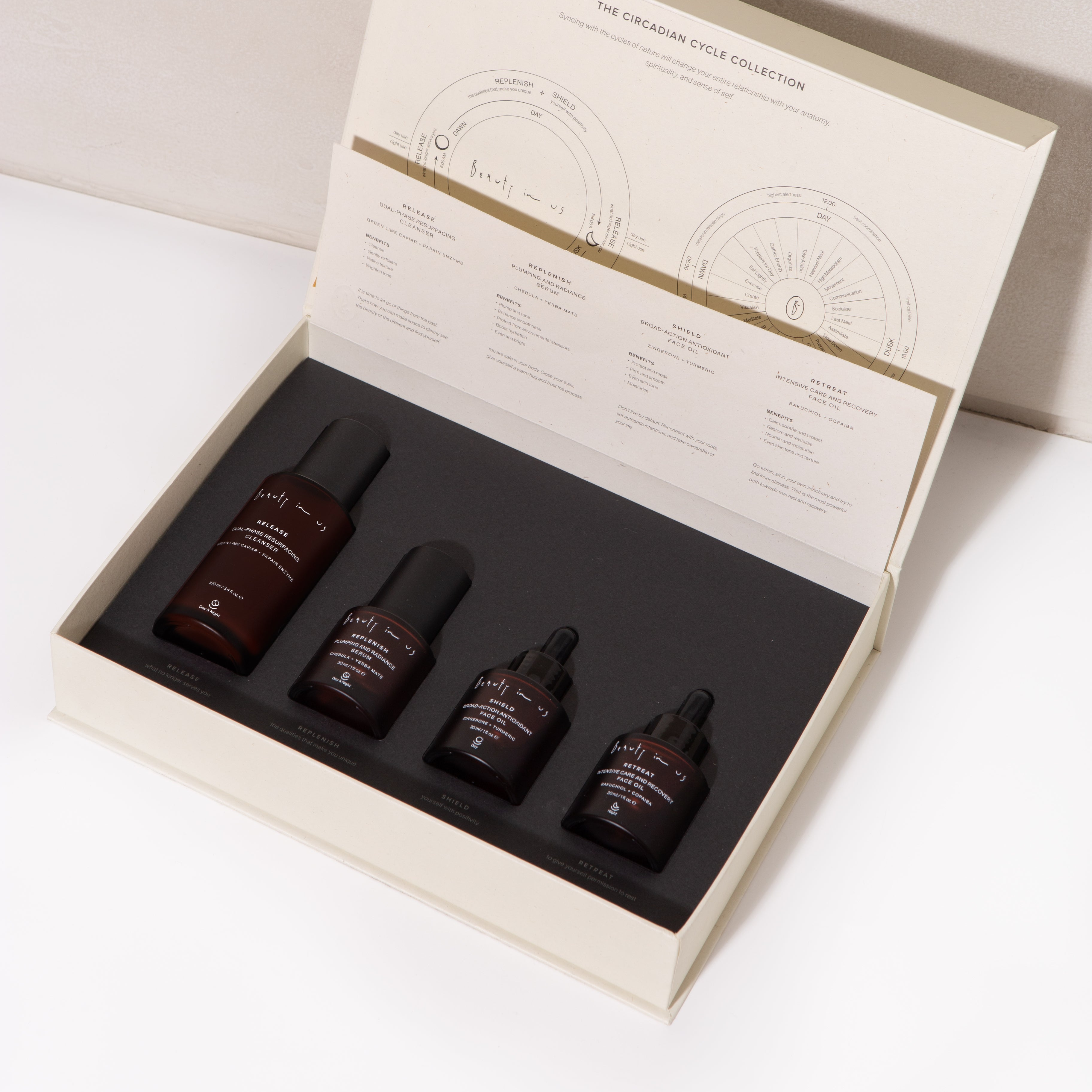
For those looking to simplify this approach, our Day & Night Skincare Duo was designed around this rhythm, pairing daytime environmental defence with nighttime repair and regeneration.
Where the CycleSync Blueprint™ Comes In
At Beauty in Us, these principles form the foundation of our CycleSync Blueprint™.
The CycleSync Blueprint™ was developed around a simple observation: when care aligns with the body’s natural rhythms, results often feel calmer, more balanced, and more sustainable.
The framework rests on three pillars: Together, these pillars transform skincare from a collection of products into a rhythm-aligned system of care for the skin, the mind and the body.
Not louder.
Not more complicated.
Just more aligned with how the body already works and to meet you in every rhythm, shift and season you are.
References
- Hardman JA, Tobin DJ, Haslam IS, et al. The circadian clock in skin: implications for adult stem cells, tissue regeneration, cancer, aging, and immunity. Journal of Investigative Dermatology. 2015. https://pubmed.ncbi.nlm.nih.gov/25668238/
- Brown SA. Circadian clock-mediated control of skin physiology and regeneration. Nature Communications. 2016. https://www.nature.com/articles/ncomms11805
- Plikus MV, Van Spyk EN, Pham K, et al. Circadian regulation of skin stem cells and regeneration. Cell. 2015. https://pubmed.ncbi.nlm.nih.gov/25866391/
- Denda M, Tsuchiya T, Elias PM, Feingold KR. Circadian changes in skin barrier function. British Journal of Dermatology. 2002. https://pubmed.ncbi.nlm.nih.gov/12174127/
- Geyfman M, Kumar V, Liu Q, et al. Brain and muscle Arnt-like protein-1 (BMAL1) controls circadian cell proliferation and DNA damage response in epidermal stem cells. Proceedings of the National Academy of Sciences (PNAS). 2012 https://www.pnas.org/doi/10.1073/pnas.1117995109.
- Chen Y, Lyga J. Brain-skin connection: stress, inflammation and skin aging. Inflammation & Allergy – Drug Targets. 2014. https://pubmed.ncbi.nlm.nih.gov/24702781/
- Thau L, Gandhi J, Sharma S. Physiology, Cortisol. StatPearls Publishing. 2024. https://www.ncbi.nlm.nih.gov/books/NBK538239/
- Arck PC, Slominski A, Theoharides TC, et al.Neuroimmunology of stress: skin takes center stage. Journal of Investigative Dermatology. 2006. https://pubmed.ncbi.nlm.nih.gov/16845405/

Written by Ana Paula Maielo